
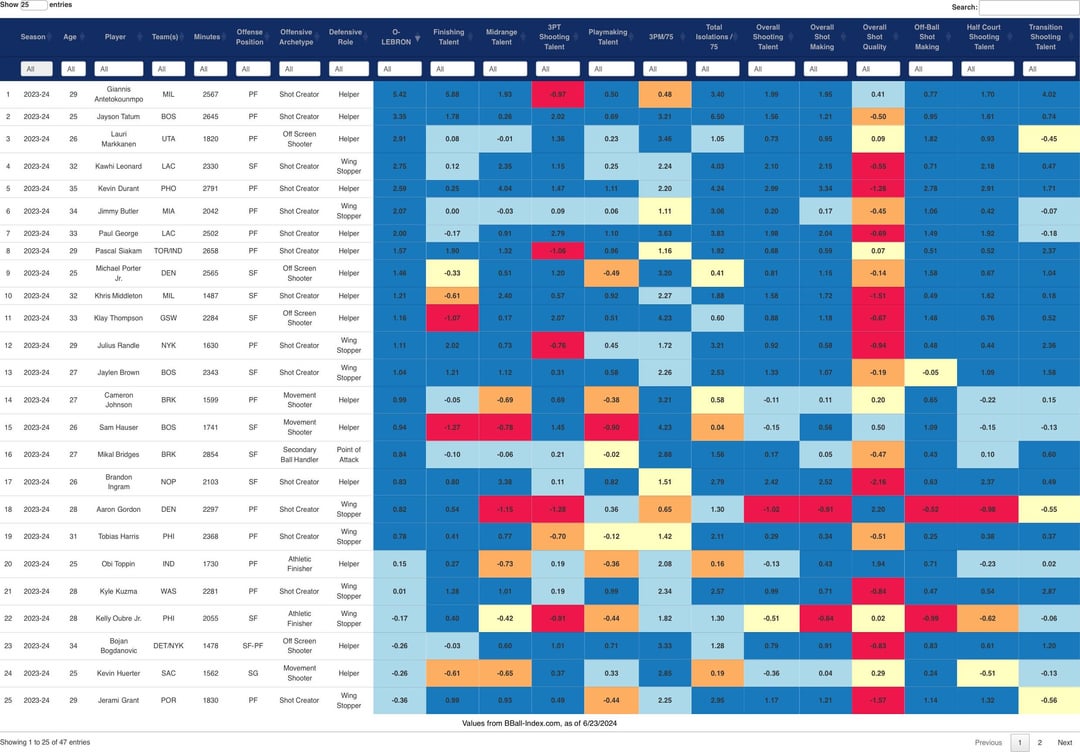
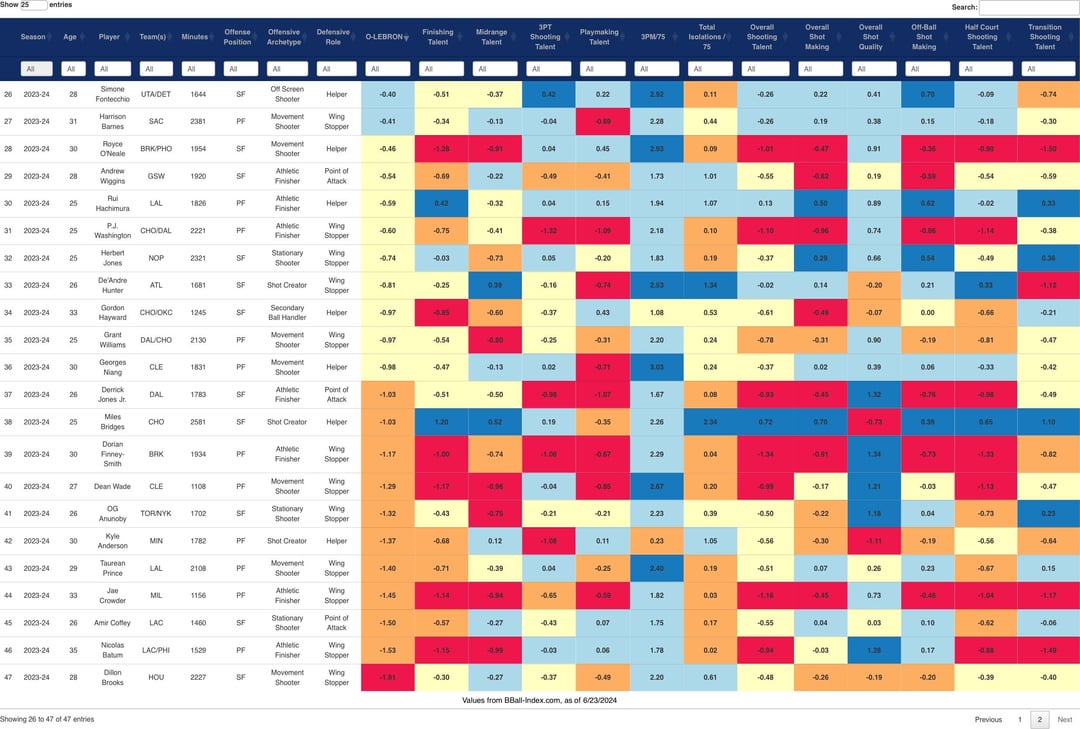
I've been doing a ton of digging around on Bball-Index for positions and roles that the Warriors need more depth in and I figured I'd share some of the aggregated data for reference for the off season roster and player acquisition discussions on here. If info/data like this is over board and/or not as interesting or fascinating to a lot of y'all as it is to me, just let me know and I'll pump the brakes on these kinds of posts.
A couple of notes:
- As far as advanced player positions (aka off-ball/on-ball guards and wings, etc.) go, I included on-ball wings but not on-ball guards because on-ball guards are predominantly primary ball handlers and that from a 20+ mpg player is not as big of a need so didn't want to muddy the pool of results with those kinds of players.
- Bball-Index defines 'Low Activity' defenders as:
Players in this role often aren't guarding high difficulty matchups, aren't involved in defending screening actions often, and also aren't active helping off of the ball on drives or at the rim. Players in this role are often purposefully deployed in less strenuous ways, and can add value with communication ability.
- I know star and 1A players, like Giannis, Kawhi, KD, etc., that are not remotely candidates to be acquisitions/roster additions are included in the results, which seems pointless, but I kept them in, instead of filtering them out, because I figured they'd be good points of reference for comparing the metrics of the others to as kind of ceiling setters to know what is and is not realistic to expect from players that are a tier or couple tiers below them, if that makes sense.
Bball-Index's definitions for some of the metrics included in the table:
OVERALL SHOOTING TALENT: Shooting Talent takes into account a player's shot making, shot quality, and shot creation. These factors help provide context that box score shooting percentages are lacking.
- SHOT MAKING: Each of our Shot Making metrics evaluate player shooting proficiency while accounting for shot quality in the given area.
- SHOT QUALITY: Shot Quality measures how difficult a player's shot attempts are. It accounts for shot location, type, defense, and movement.
- SHOT CREATION: Shot Creation measures how often a player self-generates shot attempts.
OFF-BALL SHOT MAKING: This metric evaluates a player's shooting ability on assisted shots, and takes into account Shot Quality and volume.
FINISHING TALENT: This metric evaluates a player's ability to get to and finish at the rim, using Rim Shot Creation and Rim Shot Making. You can use this metric to compare among players, with the confidence that degree of difficulty is being captured and adjusted for to allow comparison of players' talent in as neutralized an environment as possible.
- RIM SHOT QUALITY: Rim Shot Quality measures how difficult a players shot attempts are at the rim. This includes the quality of contest and type of shot attempted. These values are represented using z-scores.
- RIM SHOT MAKING: Rim Shot Making captures how well a player shoots at the rim relative to their shot quality. These values are represented using z-scores.
MID-RANGE TALENT: This metric evaluates a player's ability in the Mid-Range using Mid-Range Shot Making, Mid-Range Shot Creation and Mid-Range Shot Quality. You can use this metric to compare among players, with the confidence that degree of difficulty is being captured and adjusted for to allow comparison of players' talent in as neutralized an environment as possible.
3PT SHOOTING TALENT: This metric is made up of a combination of our 3PT Shot Making, 3PTShot Quality, and 3 PT Shot Creation. It also accounts for volume to regress down smaller samples. This seeks to capture how well of a 3-point shooter a player is in a neutral environment.
HALF COURT SHOOTING TALENT: This metric is takes into account the same factors that the Overall Shooting Talent metric does, but for half court possessions only, i.e. with possessions in transition filtered out.
TRANSITION SHOOTING TALENT: This metric is takes into account the same factors that the Overall Shooting Talent metric does, but for transition possessions only.
PLAYMAKING TALENT: Our Playmaking Talent grade analyzes a player's playmaking for teammates through their ratings in Passing Creation Volume, Passing Creation Quality, Passing Versatility, Passing Efficiency, and On-Ball Gravity (which has a small weight). This metric is designed to be as context-neutral as possible, enabling values more accurately capturing true playmaking talent and resulting in stability from year to year, even with players changing teams.
- PASSING CREATION VOLUME: Passing Creation Volume looks at a player's potential assists per 75 possessions. Potential assists are given regardless of if a teammate makes or misses a shot after receiving a pass. We pad these rates to regress smaller samples back towards the average. These values are represented using z-scores.
- PASSING CREATION QUALITY: Passing Creation Quality analyzes playmaking ability through the quality of scoring opportunities a player creates for their teammates through their passing. Regardless of whether the teammates makes or misses the look generated. Data used to calculate Passing Creation Quality includes the location of assists, as well as conversion rates on potential assists for players relative to rates for those same players passed to from other teammates and league average on types of scoring looks.
- PASSING VERSATILITY: Passing Versatility analyzes a player's playmaking ability by quantifying how full the passing repertoire is for a player by looking at Synergy passing data from scoring play types as well as SportRadar data on assist locations. This allows us to gauge who has the most range and versatility in their pass types. A player may have excellent performance within their passing style but not have the range as a playmaker to make other kinds of passes (kick outs on drives, etc.). This metric identifies that spread of playmaking versatility and rewards players who are more versatile. Several tiers of spread are identified through the data, which is why you'll see groups of players with the same values. The higher the spread, the fewer players you'll see in the tier. These values are represented using z-scores.
- PASSING EFFICIENCY: Passing Efficiency analyzes how well a player takes care of the ball as a passer, and does so by comparing rates of bad pass turnovers with expected rates, given the player's ball dominance, how often they're generating shots for teammates (via Passing Creation Volume), the quality of those shots (via Passing Creation Quality), and the versatility in pass types executed (via Passing Versatility). If you look just at turnover rates, you're lumping in a lot of turnovers that have nothing to do with passing. If looking just at rates of bad pass turnovers, real playmakers will naturally look worse and players rarely creating for others will look better. To be holistic in capturing all of that, we establish the baseline of what's expected, given a player's playmaking ask, to compare with instead and enable smarter analysis.
- ON-BALL GRAVITY: This metric aims to measure how much attention and resources a team uses trying to defend a player while on-ball. Players with high On-Ball Gravity are ones we'd expect to see double teamed more often than others and see more aggressive screen coverages to get the ball out of their hands.
Cheers to more informed dialogue, y'all!
by taygads

1 Comment
They missed way more of the *wide* open threes last year than they should have.